


Essential reading when selecting a point-spectral confocal displacement sensor
When selecting a sensor, one should not focus on a single parameter alone, but rather conduct a comprehensive assessment of the measurement range, resolution, accuracy, response time, optical parameters, environmental adaptability, and whether it genuinely meets the specific application requirements. These seven factors collectively determine whether the sensor can consistently deliver reliable data in actual production lines or laboratories.

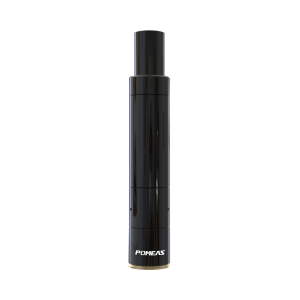
The measurement range determines the upper limit of the range, but a wider range is not necessarily better. Common spectral confocal probes can cover ranges from sub-millimetres to tens of millimetres; it is essential to ensure that the displacement of the object under test falls within the effective range, whilst allowing for a safety margin. Resolution reflects the smallest change that can be distinguished; in the field of precision measurement, nanometre-level resolution is often required. Accuracy, also known as linearity, directly relates to the deviation between the measured value and the true value; it is usually expressed as a percentage of the full scale, for example, ±0.02% F.S. Response speed refers to the sampling frequency; high-speed online inspection requires frequencies in the kilohertz range or higher to capture rapidly fluctuating surface profiles.
Optical parameters are more important than one might imagine. These include spot size, numerical aperture and working distance. A small spot size enables the measurement of microscopic protrusions or grooves, whilst the numerical aperture influences the angle of incident light and directly determines whether the sensor can measure surfaces with steep angles of inclination. As spectral confocal sensors utilise a coaxial optical path, they offer a natural advantage when measuring mirror-like surfaces, transparent objects and highly reflective materials; in such cases, it is essential to verify angular characteristics, such as whether the maximum permissible tilt angle exceeds ±30°.
Environmental adaptability must not be overlooked. Actual operating conditions often involve temperature fluctuations, oil mist, dust and vibration. High-quality sensors incorporate temperature-compensated designs, with temperature drift as low as 0.01% F.S./°C or less, and should have a protection rating of IP64 or higher to ensure long-term stability.
Most crucially, the sensor must be closely matched to the specific application scenario. Measuring the flatness of a mirrored mobile phone frame presents entirely different requirements for the probe compared to measuring the thickness of transparent glass; measuring diffuse-reflective ceramic surfaces may require a wide spot size to enhance the signal; whilst in-line measurement of transparent films demands high response speed and minimal optical power. One must not simply apply a standard selection template, but should clearly identify the material of the object under test, its surface condition, the available installation space, and the required output signal type.

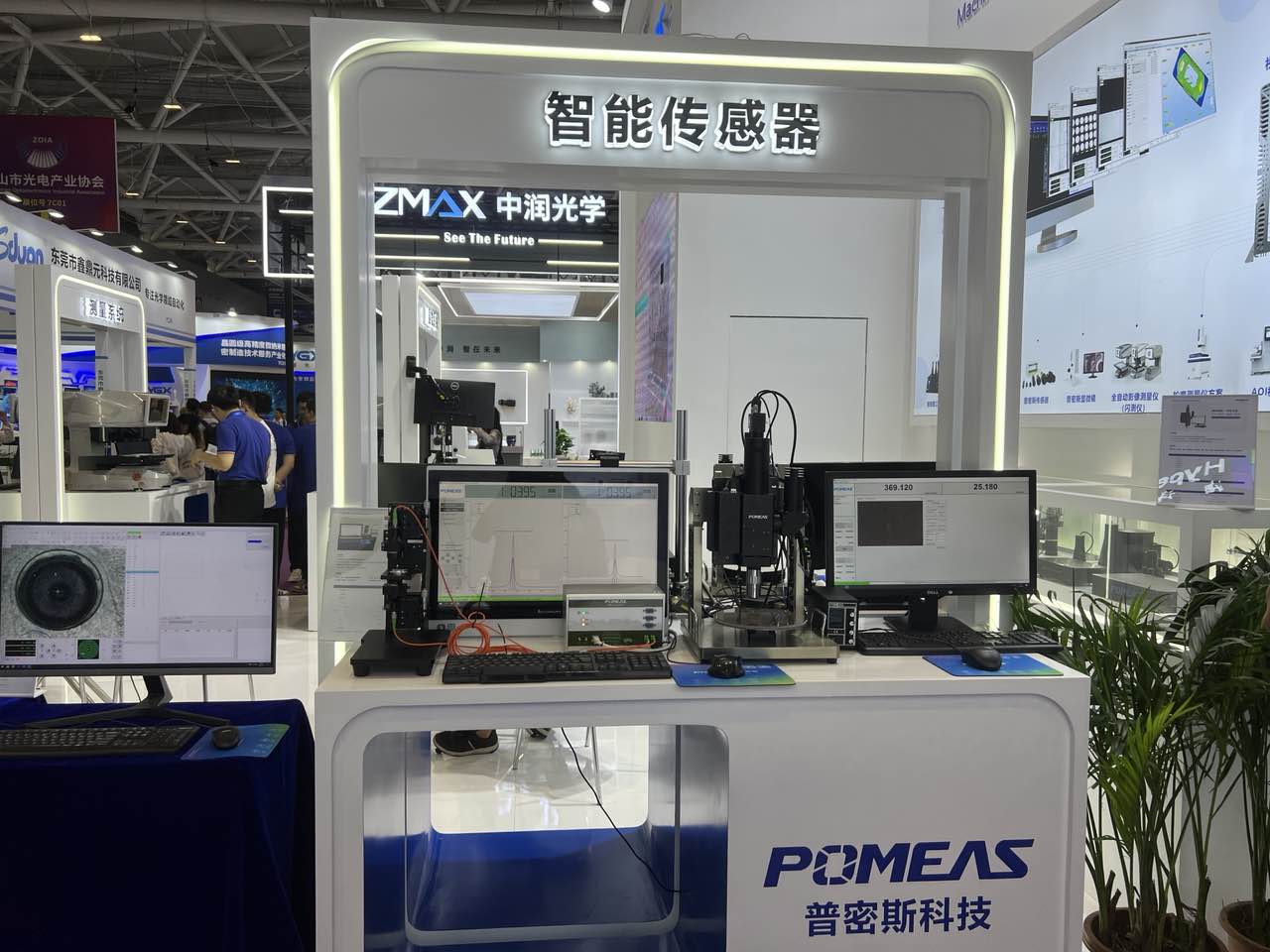
As verified in industry practice, when measuring mirror-finished aluminium alloy components, the use of a spectral confocal sensor with a numerical aperture of 0.42 ensures that linearity can be maintained within 0.03 per cent, even when the surface is tilted by up to ±25°. Meanwhile, for transparent polycarbonate sheets, after 100,000 consecutive measurements at a sampling rate of 10 kHz, the standard deviation of thickness variation was merely 0.15 micrometres. This non-contact, non-destructive method fully demonstrates the value of precise calibration.
Product recommendation
TECHNICAL SOLUTION
MORE+You may also be interested in the following information
FREE CONSULTING SERVICE
Let’s help you to find the right solution for your project!

 ASK POMEAS
  PRICE INQUIRY
  REQUEST DEMO/TEST
  FREE TRIAL UNIT
  ACCURATE SELECTION
- APPICATION CASE
- RESOURCE CENTER
- DOWNLOAD CENTER
SOLUTIONS SUPPORT
- ZOOM LENS SELECTION TOOL
- TELECENTRIC LENS SELECTION TOOL
- FA LENS SELECTION TOOL
- ZOOM RATIO TABLE
- CERTIFIED MODEL
SELECTION TOOL
- WHY POMEAS
- FAQ
- PRIVACY POLICY
- TERMS OF USE
- DELIVERY & RETURN POLICY
CUSTOMER CARE
 ADDRESS
Add.:No.68, Yongwei Road, Baizhoubian, Dongcheng District, Dongguan, China,523000
CONTACT
 Tel:+ 86-0769-2266 0867
 Fax:+ 86-0769-2266 0867
 E-mail:marketing@pomeas.com

Wechat QR code

Software Copyright :2021SR0176001 抄袭必究, 技术支持:誉新源科技