


How High-Resolution Telecentric Lenses Handle Multi-Scene Inspection
In the field of automated inspection, there is a common misconception: many engineers believe that telecentric lenses are only suitable for measuring static, flat objects. In fact, with the increase in sensor size and improvements in pixel resolution, a new generation of telecentric optical technology is breaking through this limitation.
For parallel measurement of screw threads, precision stamped metal parts, and electronic connector arrays, the process requires both the elimination of perspective distortion and the ability to clearly capture minute details in a single view. This poses a significant challenge for optical design.

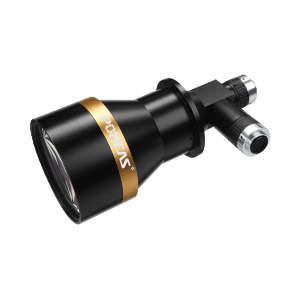
The Core Value of “Dual-Telephoto Lenses”

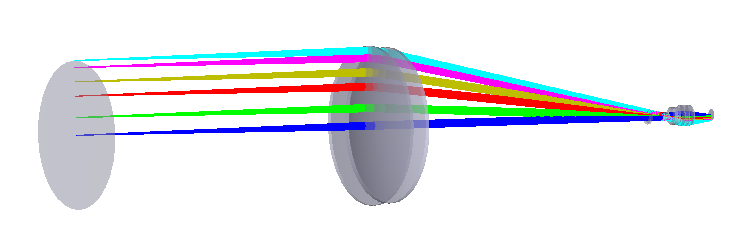
A true double-telecentric design (object-side telecentric + image-side telecentric) not only ensures stable magnification but also maximizes edge contrast. For fine scratches or burrs as small as 0.02 mm, standard lenses may lose grayscale information due to excessive light incidence angles, whereas high-resolution telecentric lenses can reproduce them clearly.
How the POMEAS Telecentric Lens Performs in Real-World Applications

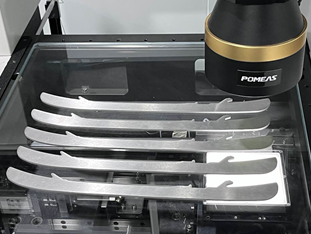
Our solution demonstrates exceptional adaptability in addressing the following challenges:
Challenge 1: Capturing minute features within a wide field of view
Traditional solutions: To achieve a wide field of view, resolution must be reduced, leading to missed detection of minor defects.
POMEAS solution: Utilizes a high-magnification objective-side telecentric design combined with a high-pixel-count image sensor. This maintains a wide objective-side field of view while supporting chips with pixel sizes as small as 3.45 μm or smaller, ensuring “wide yet sharp” imaging.
Challenge 2: Transparent or Highly Reflective Materials
Pain Point: Glass and polished metal surfaces are prone to producing bright spots or ghosting.
POMEAS Solution: Through specialized coating processes and internal stray light suppression structures, we effectively reduce glare, ensuring sharp, high-contrast images when inspecting highly reflective edges.
Selection Guidelines
-
The thickness exceeds 5 mm, and dimensional tolerances of the top and bottom surfaces need to be measured.
-
The object being measured is in motion or rotating within the field of view.
-
Measurement accuracy must be at the micrometer level (±0.01 mm).
Product recommendation
TECHNICAL SOLUTION
MORE+You may also be interested in the following information
FREE CONSULTING SERVICE
Let’s help you to find the right solution for your project!
 ASK POMEAS
  PRICE INQUIRY
  REQUEST DEMO/TEST
  FREE TRIAL UNIT
  ACCURATE SELECTION
- APPICATION CASE
- RESOURCE CENTER
- DOWNLOAD CENTER
SOLUTIONS SUPPORT
- ZOOM LENS SELECTION TOOL
- TELECENTRIC LENS SELECTION TOOL
- FA LENS SELECTION TOOL
- ZOOM RATIO TABLE
- CERTIFIED MODEL
SELECTION TOOL
- WHY POMEAS
- FAQ
- PRIVACY POLICY
- TERMS OF USE
- DELIVERY & RETURN POLICY
CUSTOMER CARE
 ADDRESS
Add.:No.68, Yongwei Road, Baizhoubian, Dongcheng District, Dongguan, China,523000
CONTACT
 Tel:+ 86-0769-2266 0867
 Fax:+ 86-0769-2266 0867
 E-mail:marketing@pomeas.com

Wechat QR code

Software Copyright :2021SR0176001 抄袭必究, 技术支持:誉新源科技