


Dual-telecentric Lenses: The Cornerstone of Precision Vision for “What You See Is What You Measure”
The Core Challenges of Precision Measurement
In the era of industrial automation, machine vision has become central to quality control. However, when using standard lenses for precision measurements, even a slight change in height or positional shift can lead to significant measurement errors. This is due to perspective errors, image distortion, and depth-of-field limitations. How can we overcome these challenges to obtain absolutely reliable measurement data? Dual-telecentric lenses are the optical solution designed specifically for this purpose.
The principle of a double-telecentric lens: telecentric on the object side + telecentric on the image side
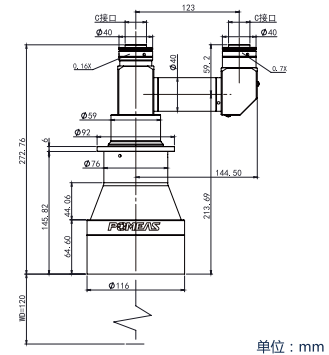
① Object-side telecentric: Ensures that only light rays perpendicular to the surface of the object being measured (and parallel to the principal axis) enter the lens. As long as the object remains within the depth of field, its movement forward or backward will not alter the angle of the light rays entering the lens, thereby producing an image of consistent size on the image sensor.
② Image-side telecentricity: Ensures that the principal rays strike the camera sensor at a perpendicular angle. This minimizes variations in the angle of incidence at the sensor edges, optimizing image quality at the edges.
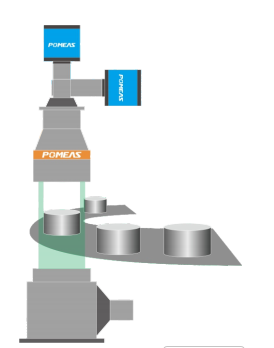
Key Feature 1: Constant Magnification Regardless of Object Distance
This is its most fundamental advantage. Based on a parallel optical path design, the image size remains strictly constant regardless of whether the object moves forward or backward within the depth of field. This completely eliminates perspective errors, ensuring that measurement results depend solely on the object’s actual dimensions and are independent of its spatial position.
Key Feature 2: Near-Zero Distortion Imaging
Through a precise combination of lenses and optical corrections, the dual-telecentric lens achieves extremely low image distortion (typically less than 0.1% or even lower). This ensures that every pixel, from the center to the edge of the image, possesses a completely consistent scale equivalent, realizing the ultimate ideal of “what you see is what you measure” across the entire field of view.
Key Feature 3: Combining a Deep Depth of Field with High Resolution
Thanks to their unique optical design, double-telecentric lenses deliver excellent resolution at both the center and edges while maintaining a large depth of field. This allows for clear imaging across the entire feature area when inspecting objects with height variations or slight irregularities, eliminating the need for frequent refocusing and reducing reliance on precision positioning fixtures as well as system complexity.
Applications for Double-Telecentric Lenses
-
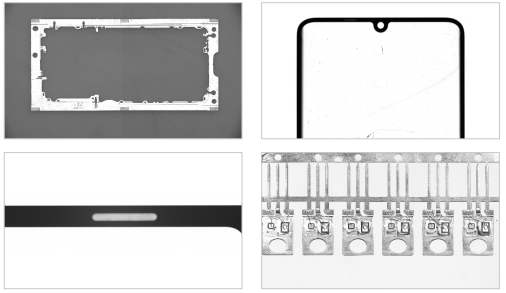
Precision dimensional measurement: For two-dimensional measurements such as line widths on semiconductor chips, pin pitch on connectors, and hole diameters and spacing on precision-machined parts, which require micron-level repeatability, a non-dual-telecentric lens is essential.
-
High-Precision Defect Detection: In inspections of electronic component surfaces, smartphone glass covers, and lithium-ion battery electrodes, it clearly and consistently identifies minute defects such as scratches, foreign objects, and missing areas with an extremely low false positive rate.
-
Sub-pixel Level Positioning and Alignment: During processes such as PCB assembly and chip mounting, it enables ultra-precise positioning of reference marks, providing robots with accurate coordinates.
-
Indirect 3D contour measurement: Combined with specialized parallel backlighting, it enables indirect, high-precision measurement of parameters such as object flatness and step height through the clear contours of object edges.
How to Choose a Dual-Telecentric Lens for Your Project?
-
Magnification: Calculated based on the size of the object being inspected (field of view) and the camera’s pixel resolution (inspection accuracy). The magnification is fixed and cannot be adjusted.
-
Working Distance: The distance from the front of the lens to the object being inspected, which must meet mechanical installation space requirements.
-
Depth of Field: Must exceed the maximum height variation of the object along the axial (Z) direction to ensure the entire object is in focus.
-
Resolution and Image Circle: The lens resolution must match the pixel size of the camera sensor; the lens’s image circle must fully cover the camera’s sensor plane, with particular attention to ensuring edge sharpness.
The potential of dual-telecentric lenses must be properly harnessed. They must be paired with suitable light sources, such as parallel backlighting (for contour measurement) or high-quality coaxial light (for surface feature inspection), and connected to high-resolution, low-noise industrial cameras. Only through the perfect synergy of optics, mechanics, and electronics can the potential of “what you see is what you measure” be fully realized.
Product recommendation
TECHNICAL SOLUTION
MORE+You may also be interested in the following information
FREE CONSULTING SERVICE
Let’s help you to find the right solution for your project!
 ASK POMEAS
  PRICE INQUIRY
  REQUEST DEMO/TEST
  FREE TRIAL UNIT
  ACCURATE SELECTION
- APPICATION CASE
- RESOURCE CENTER
- DOWNLOAD CENTER
SOLUTIONS SUPPORT
- ZOOM LENS SELECTION TOOL
- TELECENTRIC LENS SELECTION TOOL
- FA LENS SELECTION TOOL
- ZOOM RATIO TABLE
- CERTIFIED MODEL
SELECTION TOOL
- WHY POMEAS
- FAQ
- PRIVACY POLICY
- TERMS OF USE
- DELIVERY & RETURN POLICY
CUSTOMER CARE
 ADDRESS
Add.:No.68, Yongwei Road, Baizhoubian, Dongcheng District, Dongguan, China,523000
CONTACT
 Tel:+ 86-0769-2266 0867
 Fax:+ 86-0769-2266 0867
 E-mail:marketing@pomeas.com

Wechat QR code

Software Copyright :2021SR0176001 抄袭必究, 技术支持:誉新源科技