


Three Questions to Help You Understand Spectral Confocal Displacement Sensors
Q1: What is a spectral confocal displacement sensor?
A: A spectral confocal displacement sensor is a noncontact, high-precision optical measuring instrument based on the principles of white light dispersion and confocal imaging.

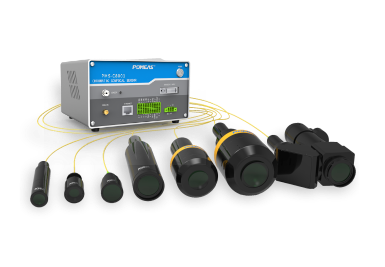
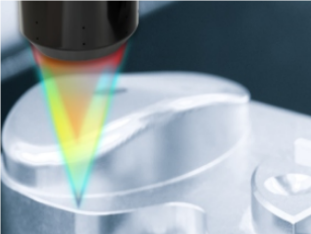
1. Core Principle: A special dispersive lens is used to decompose broad-spectrum white light, focusing monochromatic light of different wavelengths at different positions along the optical axis to establish a one-to-one correspondence between wavelength and axial distance.
2. Measurement Logic: Only the reflected light of the corresponding wavelength at the focal point on the surface of the object being measured passes through the confocal pinhole. After the spectrometer decodes the peak wavelength, the data is converted to yield precise displacement or thickness values.
3. Basic Characteristics: This is a non-contact measurement device capable of achieving nanometer-level measurement accuracy and offering exceptional adaptability to various materials and complex surfaces.
Q2. What benefits does a spectral confocal displacement sensor offer?
A: Thanks to its unique technical characteristics, it can achieve high-precision, high-stability measurements that traditional laser sensors cannot.

1. Ultra-high measurement accuracy: Resolution up to 2 nm; linear error of less than ±0.03 μm on certain models; minimum spot diameter of just φ2.7 μm, capable of detecting nanoscale micro-deformations and dimensional deviations.
2. Stable measurement on all materials: Unaffected by special materials such as highly reflective mirrors, transparent glass, black rubber, and diffusely reflective fabrics; provides stable data output without the need for additional parameter adjustments.
3. Breakthrough Capabilities: A single sensor can measure the thickness of multi-layered transparent materials and support measurements on highly reflective surfaces with angles exceeding ±45°, eliminating the shadows and measurement blind spots associated with traditional triangulation methods.
4. Industrial-Grade Adaptability: With a sampling frequency of up to 70 kHz, strong resistance to ambient light interference, and high thermal stability due to the probe’s lack of moving parts, it can be directly deployed on high-temperature, high-pressure industrial production lines to enable in-line inspection.
Q3: In which industries can spectral confocal displacement sensors be used?

1. Semiconductor Industry: Used for wafer warpage inspection, photoresist thickness measurement, and chip packaging height and bump size inspection to ensure nanometer-level process precision in chip manufacturing.
2. 3C Electronics Industry: Inspects the flatness of smartphone screens, gaps in camera modules, and the height of PCB solder joints and component spacing to prevent product failures caused by microscopic defects.
3. Precision Machinery and Automotive Industries: Measures form and position tolerances of aircraft engine blades and critical dimensions of automotive engine pistons and crankshafts to ensure machining precision of core moving parts.
4. Biomedical Industry: Non-contact measurement of corneal thickness and tooth surface topography; inspection of machining precision for artificial joints and cardiac stents; also used for wall thickness inspection of pharmaceutical glass vials to ensure safe drug storage.
5. Research and Materials Industry: Measures surface roughness of new materials, deformation of micro- and nanostructures, and the curvature and flatness of optical lenses, supporting cutting-edge research in materials science and micro- and nanotechnology.
6. Lithium-Ion Battery and Packaging Industries: Inspects the thickness of lithium-ion battery electrodes, as well as the thickness and seal integrity of packaging films, ensuring production consistency for new energy products and pharmaceutical packaging.
Product recommendation
TECHNICAL SOLUTION
MORE+You may also be interested in the following information
FREE CONSULTING SERVICE
Let’s help you to find the right solution for your project!
 ASK POMEAS
  PRICE INQUIRY
  REQUEST DEMO/TEST
  FREE TRIAL UNIT
  ACCURATE SELECTION
- APPICATION CASE
- RESOURCE CENTER
- DOWNLOAD CENTER
SOLUTIONS SUPPORT
- ZOOM LENS SELECTION TOOL
- TELECENTRIC LENS SELECTION TOOL
- FA LENS SELECTION TOOL
- ZOOM RATIO TABLE
- CERTIFIED MODEL
SELECTION TOOL
- WHY POMEAS
- FAQ
- PRIVACY POLICY
- TERMS OF USE
- DELIVERY & RETURN POLICY
CUSTOMER CARE
 ADDRESS
Add.:No.68, Yongwei Road, Baizhoubian, Dongcheng District, Dongguan, China,523000
CONTACT
 Tel:+ 86-0769-2266 0867
 Fax:+ 86-0769-2266 0867
 E-mail:marketing@pomeas.com

Wechat QR code

Software Copyright :2021SR0176001 抄袭必究, 技术支持:誉新源科技