


In the field of industrial online inspection, 2D vision systems can effectively identify surface defects such as scratches, dirt, and missing parts, but they are unable to detect 3D dimensional information such as height differences, flatness, step differences, and warpage. Although traditional contact measurement probes (such as dial indicators and CMM probes) offer high accuracy, they are slow and unsuitable for workpieces with soft, high-temperature, or easily scratched surfaces. Faced with high-precision applications such as coating thickness inspection of battery electrodes, solder paste height measurement on PCBs, and adhesive path contour scanning, the industry urgently needs a non-contact measurement technology that can “see height” and operates at “high speed.”

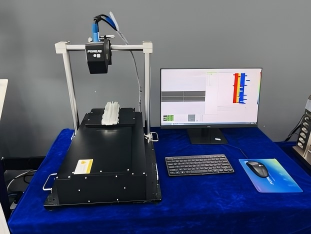
The line laser profile sensor was developed specifically to address this challenge. By combining the principle of laser triangulation with high-speed image capture, it captures complete 3D profile data of an object’s surface in a single scan, making it the core sensing component of online 3D inspection.
I. Overview of the Principle: Triangulation for Precise Contour Reconstruction

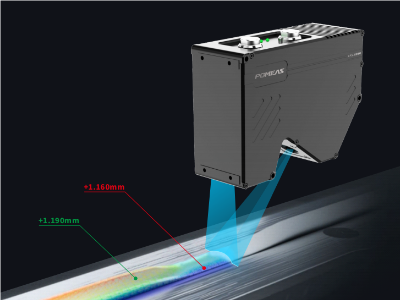
Line laser profilometers integrate a semiconductor laser and a high-speed CMOS imaging chip. During operation, the laser projects a thin line onto the surface of the object being measured, while the CMOS chip captures an image of the laser line’s deformation from another angle. Based on the curvature and positional offset of the laser line, the system uses trigonometric relationships to calculate the height distribution of the object’s surface at that cross-section in real time, generating a set of high-precision 3D point cloud data with a single frame. By coordinating with a motion platform (conveyor belt, XY stage) or a robotic arm to move and continuously scan multiple cross-sections, a complete 3D topography can be reconstructed.
II. Micrometer-level Precision and High-Speed Scanning, Optimized for In-Line Production Cycles
To meet the inspection requirements of the precision manufacturing sector, line laser profilometers can achieve micron-level repeatability on both the X and Z axes. For example, in edge inspection of coated lithium battery electrodes, they can clearly distinguish subtle variations in coating thickness, providing data support for closed-loop coating control. At the same time, their scanning speed can reach several thousand hertz (Hz) or higher—meaning thousands of profile lines can be captured per second. When paired with high-speed conveyor belts, they enable full-coverage in-line inspection of materials at speeds of several hundred millimeters per second without reducing the production line’s cycle time.
III. Suitable for Multiple Materials and Complex Surfaces, Ensuring No Missed Defects
Line lasers use blue or red laser sources and are optimized for the reflective properties of different materials. For materials such as mirror-finished metals, highly reflective plastics, and black rubber—where traditional laser sensors are prone to “line loss”—the new generation of sensors incorporates HDR (High Dynamic Range) or multi-exposure algorithms. These algorithms automatically adjust imaging parameters based on surface reflectivity, ensuring stable extraction of the laser line center. This means that whether measuring orange peel on a car’s paint surface or detecting the height of rivets on a smartphone frame, stable and reliable contour data can be obtained.
IV. Easy Integration into Existing Systems Without Complex Programming
Line laser profilometers typically come with a universal SDK and user-friendly configuration software. Users simply need to set the scanning area, exposure time, and trigger method to directly output profile data and point cloud information. The communication interfaces support common industrial protocols such as GigE, Ethernet/IP, and Modbus TCP, enabling seamless integration with PLCs, robots, and image processing systems, thereby significantly lowering the technical barriers to system integration.
Use Cases:

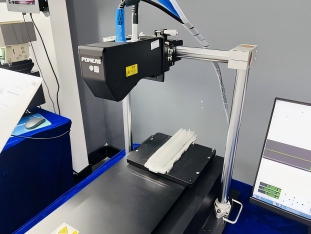
From measuring the thickness of power battery electrodes and the height of electronic connector pins to scanning tire tread depth and inspecting the coplanarity of chip packages,Line laser profilometers are becoming standard equipment in industrial 3D measurement thanks to their unique advantages of non-contact operation, high precision, and real-time online measurement.
Product recommendation
TECHNICAL SOLUTION
MORE+You may also be interested in the following information
FREE CONSULTING SERVICE
Let’s help you to find the right solution for your project!
 ASK POMEAS
  PRICE INQUIRY
  REQUEST DEMO/TEST
  FREE TRIAL UNIT
  ACCURATE SELECTION
- APPICATION CASE
- RESOURCE CENTER
- DOWNLOAD CENTER
SOLUTIONS SUPPORT
- ZOOM LENS SELECTION TOOL
- TELECENTRIC LENS SELECTION TOOL
- FA LENS SELECTION TOOL
- ZOOM RATIO TABLE
- CERTIFIED MODEL
SELECTION TOOL
- WHY POMEAS
- FAQ
- PRIVACY POLICY
- TERMS OF USE
- DELIVERY & RETURN POLICY
CUSTOMER CARE
 ADDRESS
Add.:No.68, Yongwei Road, Baizhoubian, Dongcheng District, Dongguan, China,523000
CONTACT
 Tel:+ 86-0769-2266 0867
 Fax:+ 86-0769-2266 0867
 E-mail:marketing@pomeas.com

Wechat QR code

Software Copyright :2021SR0176001 抄袭必究, 技术支持:誉新源科技