


Differences Between Autofocus and Manual Focus Industrial Cameras
I. Key Difference: Intelligent Focusing vs Manual Intervention

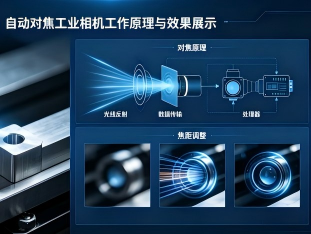
1. Industrial cameras with autofocus
① Technical Principle: The system calculates the distance to the target in real time using sensors (phase detection, laser ranging) or algorithms (contrast analysis), and drives a motor or liquid lens to automatically adjust the focus without manual intervention.
② Response Speed: Millisecond-level focusing (e.g., completed within 0.1 seconds), suitable for high-speed dynamic scenarios (e.g., product inspection on conveyor belts).
③ Applicable Scenarios: Environments requiring efficient, continuous operation, such as those with frequently changing target distances, unmanned production lines, and robot vision guidance.
2. Manual-focus industrial camera
① Technical Principle: Relying on manual rotation of the lens focus ring or inputting fixed focal length parameters via software; requires prior calibration or on-site adjustment.
② Response Speed: Depends on the operator’s proficiency; a single focus adjustment may take anywhere from a few seconds to several tens of seconds.
③ Suitable Applications: Shooting at fixed distances (such as testing fixed samples in a laboratory), low-cost, simple scenarios, or tasks requiring minimal focus accuracy.
II. Performance Comparison: Accuracy, Stability, and Adaptability

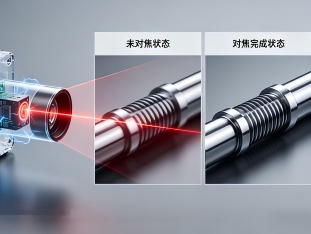
1. Focus accuracy
(1) Autofocus: Supports micron-level dynamic tracking; for example, in semiconductor chip inspection, it can adjust the focal length in real time to ensure component position recognition accuracy of ≤0.01 mm.
(2) Manual focus: Relies on manual calibration and is susceptible to operator error, resulting in significant fluctuations in accuracy, particularly during repetitive tasks.
2. Depth of field coverage
(1) Autofocus: By using algorithms to extend the effective depth of field (e.g., multi-focus fusion technology), a single camera can capture targets at different heights (e.g., packages with a 50-centimeter height difference in logistics sorting).
(2) Manual focus: The depth of field is fixed, requiring frequent refocusing to accommodate changes in target distance.
3. Environmental adaptability
(1) Autofocus: Features vibration resistance and temperature stability (e.g., industrial cameras can operate reliably in environments ranging from -20°C to 60°C), making them suitable for complex industrial settings.
(2) Manual focus: Requires a stable mounting platform; temperature fluctuations or mechanical vibrations may cause the focus to drift, necessitating regular maintenance and calibration.
4. Repeatability
(1) Autofocus: Consistent focusing results for the same target, making it suitable for standardized production processes.
(2) Manual focus: Manual operation is subject to uncontrollable deviations, and prolonged use may lead to decreased efficiency due to fatigue.
Product recommendation
TECHNICAL SOLUTION
MORE+You may also be interested in the following information
FREE CONSULTING SERVICE
Let’s help you to find the right solution for your project!
 ASK POMEAS
  PRICE INQUIRY
  REQUEST DEMO/TEST
  FREE TRIAL UNIT
  ACCURATE SELECTION
- APPICATION CASE
- RESOURCE CENTER
- DOWNLOAD CENTER
SOLUTIONS SUPPORT
- ZOOM LENS SELECTION TOOL
- TELECENTRIC LENS SELECTION TOOL
- FA LENS SELECTION TOOL
- ZOOM RATIO TABLE
- CERTIFIED MODEL
SELECTION TOOL
- WHY POMEAS
- FAQ
- PRIVACY POLICY
- TERMS OF USE
- DELIVERY & RETURN POLICY
CUSTOMER CARE
 ADDRESS
Add.:No.68, Yongwei Road, Baizhoubian, Dongcheng District, Dongguan, China,523000
CONTACT
 Tel:+ 86-0769-2266 0867
 Fax:+ 86-0769-2266 0867
 E-mail:marketing@pomeas.com

Wechat QR code

Software Copyright :2021SR0176001 抄袭必究, 技术支持:誉新源科技