


Definition and Principles of a Flash Tester

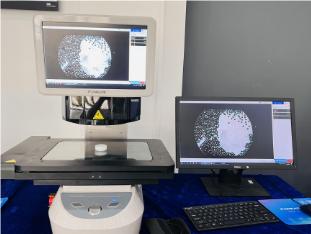
A flash measurement system is a high-precision, rapid measurement device that utilizes optical imaging and advanced algorithms. Its core principle involves capturing two-dimensional or three-dimensional images of the object being measured using a high-resolution industrial camera, and then using image processing software (such as edge detection and sub-pixel analysis) to instantly and accurately calculate geometric parameters such as dimensions, shape, and position. Some high-end models also incorporate laser ranging or structured light technology to enable three-dimensional topography measurement.
Key Features of the Flash Tester
1. Ultra-high-speed measurement: A single measurement cycle typically takes 1–3 seconds, offering dozens of times the efficiency of traditional coordinate measuring machines (CMMs).
2. Non-contact inspection: Avoids workpiece deformation or scratches that can result from contact measurement, making it particularly suitable for soft materials (such as rubber and films) or precision electronic components.
3. Full-dimension coverage: A single image capture can simultaneously acquire multiple feature parameters (such as hole diameter, spacing, and angle), eliminating errors caused by repeated setup.
4. Intelligent operation: Equipped with features such as auto-focus, one-click measurement, and CAD comparison, the learning curve is significantly lower than that of traditional measuring equipment.
Technical Advantages of the Flash Tester
1. Accuracy Assurance: Utilizing high-precision optical systems (such as telecentric lenses) and sub-pixel-level algorithms, measurement repeatability reaches ±0.001 mm.
2. Environmental Adaptability: Some models are equipped with a temperature compensation system, ensuring stable measurements in environments ranging from -10°C to 50°C.
3. Data Traceability: Automatically generates inspection reports containing measurement values, deviation charts, and trend analysis, and supports SPC (Statistical Process Control).
Typical Applications of the Flash Tester
1. Precision Manufacturing: Inspecting the flatness of smartphone mid-frames and the accuracy of button hole positions; measuring the cylindricity and thread parameters of automotive connecting rods; verifying the dimensional compliance of medical devices (such as catheters and stents).
2. Electronics Industry: Inspecting PCB pad spacing and component coplanarity; measuring chip lead width and package height
Product recommendation
TECHNICAL SOLUTION
MORE+You may also be interested in the following information
FREE CONSULTING SERVICE
Let’s help you to find the right solution for your project!
 ASK POMEAS
  PRICE INQUIRY
  REQUEST DEMO/TEST
  FREE TRIAL UNIT
  ACCURATE SELECTION
- APPICATION CASE
- RESOURCE CENTER
- DOWNLOAD CENTER
SOLUTIONS SUPPORT
- ZOOM LENS SELECTION TOOL
- TELECENTRIC LENS SELECTION TOOL
- FA LENS SELECTION TOOL
- ZOOM RATIO TABLE
- CERTIFIED MODEL
SELECTION TOOL
- WHY POMEAS
- FAQ
- PRIVACY POLICY
- TERMS OF USE
- DELIVERY & RETURN POLICY
CUSTOMER CARE
 ADDRESS
Add.:No.68, Yongwei Road, Baizhoubian, Dongcheng District, Dongguan, China,523000
CONTACT
 Tel:+ 86-0769-2266 0867
 Fax:+ 86-0769-2266 0867
 E-mail:marketing@pomeas.com

Wechat QR code

Software Copyright :2021SR0176001 抄袭必究, 技术支持:誉新源科技