


How Image Dimension Measurement Instruments Address the Challenges of Measuring Hardware Dimensions
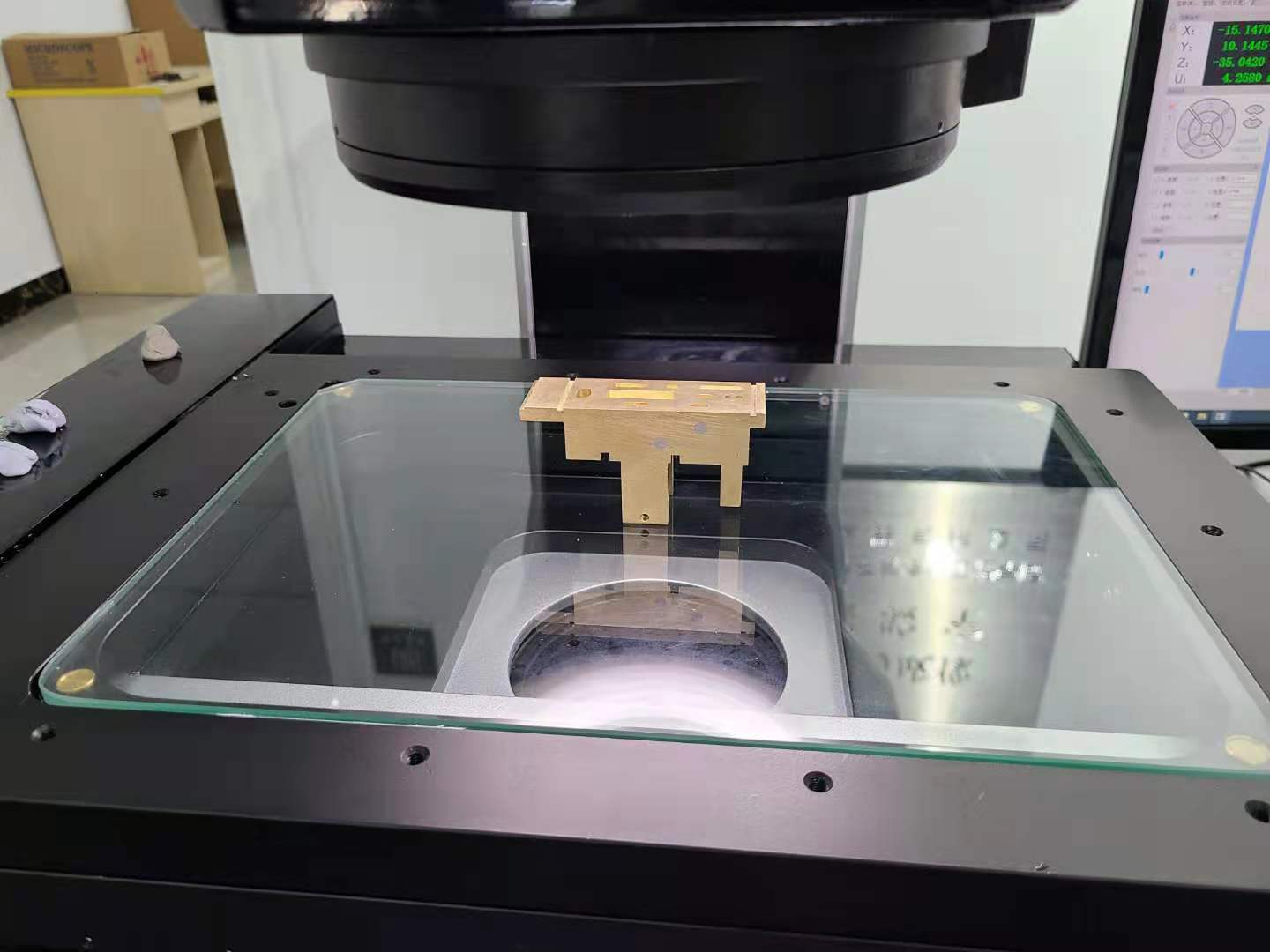
What are the common challenges in measuring the dimensions of hardware components?

-
Complex shapes make it difficult to determine measurement locations: Many hardware components feature irregular contours, internal cavities, grooves, or intersecting holes, making it impossible for traditional contact gauges to find a stable reference surface, and resulting in poor consistency when manually selecting measurement points.
-
Surface reflections make image capture difficult: Electroplated, polished, and smooth metal surfaces produce strong reflections, causing ordinary vision systems to easily suffer from overexposure or dark areas, and leading to inaccurate edge detection.
-
Small-sized parts require high-precision instruments: Micro screws, washers, electronic connectors, and other components have feature dimensions in the millimeter or even micrometer range, demanding extremely high instrument resolution and repeatability.
-
Diverse materials and surface treatments affect measurement results: Different materials (stainless steel, copper, aluminum alloy) and treatments such as sandblasting, oxidation, and plating can cause low contrast and texture interference, making it difficult for traditional algorithms to reliably identify boundaries.
Solution:

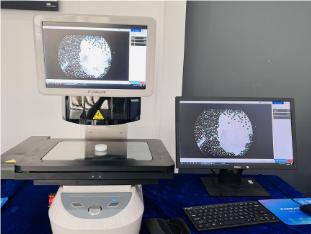
The image dimension measuring instrument provides a systematic solution to the challenges mentioned above. Its core components include a high-resolution camera, specialized image processing algorithms, and a variety of contrast adjustment features.
1. Handling Complex Shapes: Intelligent Edge Detection and Multi-Reference Localization
Using a sub-pixel edge extraction algorithm, the instrument automatically captures geometric features such as arcs, straight lines, and intersection points. Even when parts lack a clear reference plane, it can establish a workpiece coordinate system through CAD template matching or feature fitting. For simultaneous measurement of multiple areas, all dimensioning can be completed with a single click, eliminating the uncertainty associated with manual point selection while significantly improving measurement efficiency.
2. Overcoming Surface Reflections: Multi-Angle Lighting and Dynamic Image Synthesis
It features built-in programmable segmented annular lighting, coaxial lighting, and backlighting, and supports polarization filters. When measuring reflective objects, the system automatically switches between lighting configurations and performs multi-frame HDR (High Dynamic Range) compositing to clearly capture both overexposed reflective areas and shadow details simultaneously. Combined with adaptive contrast adjustment, edge artifacts are effectively suppressed under strong lighting conditions, resulting in sharper edge transitions.
3. Achieving high-precision measurements of small dimensions: High-resolution optical systems and algorithmic compensation
Equipped with a low-distortion double-telecentric lens and a high-resolution CMOS sensor, it achieves a physical resolution of up to the micrometer level per pixel. Combined with sub-pixel interpolation technology, its edge-detection accuracy far exceeds the physical pixel size. A precision motorized stage and autofocus ensure that every measurement is taken at the optimal focal plane, guaranteeing the repeatability of fine features from the outset.
4. Adaptation to Multiple Materials and Surface Conditions: Material-Adaptive Illumination and Contrast Enhancement
By analyzing image histograms in real time, the instrument automatically adjusts illumination intensity, gain, and exposure time, and can call up measurement programs tailored to different surface treatments. For parts with dark oxide layers or transparent coatings, the use of specialized wavelength light sources and image enhancement filters ensures that even low-contrast edges are reliably detected, guaranteeing the universality and consistency of measurement results.
Product recommendation
TECHNICAL SOLUTION
MORE+You may also be interested in the following information
FREE CONSULTING SERVICE
Let’s help you to find the right solution for your project!
 ASK POMEAS
  PRICE INQUIRY
  REQUEST DEMO/TEST
  FREE TRIAL UNIT
  ACCURATE SELECTION
- APPICATION CASE
- RESOURCE CENTER
- DOWNLOAD CENTER
SOLUTIONS SUPPORT
- ZOOM LENS SELECTION TOOL
- TELECENTRIC LENS SELECTION TOOL
- FA LENS SELECTION TOOL
- ZOOM RATIO TABLE
- CERTIFIED MODEL
SELECTION TOOL
- WHY POMEAS
- FAQ
- PRIVACY POLICY
- TERMS OF USE
- DELIVERY & RETURN POLICY
CUSTOMER CARE
 ADDRESS
Add.:No.68, Yongwei Road, Baizhoubian, Dongcheng District, Dongguan, China,523000
CONTACT
 Tel:+ 86-0769-2266 0867
 Fax:+ 86-0769-2266 0867
 E-mail:marketing@pomeas.com

Wechat QR code

Software Copyright :2021SR0176001 抄袭必究, 技术支持:誉新源科技