


How do telecentric lenses differ from FA lenses in terms of application?

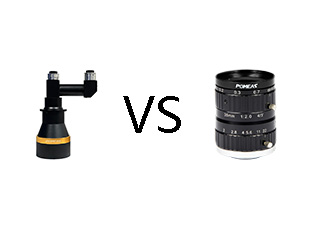
1. Differences in Measurement Logic
-
Telecentric lenses: Focus on absolute values.
When using telecentric lenses, users typically want to directly obtain the actual physical dimensions of an object (for example: Is the diameter of this hole 10 mm ± 0.01 mm?). This requires the lens to have a constant magnification, allowing users to directly calibrate the pixels and thereby derive the physical dimensions.
-
FA Lenses: Focus on Relative Values.
FA lenses are more commonly used for “presence/absence” detection, position guidance (Pick-and-Place), or rough classification. Although they can also be used for measurement, the presence of parallax and distortion often requires complex calibration compensation, and accuracy is easily affected by the object’s placement.
2. Differences in Working Distance and Spatial Layout
-
Telecentric Lenses: Limited by the Object-Side Field of View.
The design of telecentric lenses dictates that their working distance is typically fixed, and the object-side field of view (the actual range of objects that can be captured) cannot exceed the diameter of the lens’s front element. This means that to inspect a 100mm object, the lens must have a diameter of at least 100mm, resulting in a large, heavy, and expensive lens. When planning the application layout, sufficient space and load-bearing capacity must be reserved for the lens.
-
FA Lenses: Flexible and Compact.
FA lenses follow the “pinhole imaging” principle, allowing for a small form factor and light weight. As long as the working distance is sufficient, they can capture a field of view much larger than their own diameter. Therefore, FA lenses are easier to install and position in automated equipment with limited space.
3. Adaptability to Light and Environment
-
Telecentric Lenses: Demanding and Specialized.
Since telecentric lenses only accept parallel light, they have high requirements for light sources and typically need to be used with telecentric parallel light sources, especially when measuring the edges of opaque objects under transmitted illumination. Such light sources are also quite expensive. However, their advantage lies in their ability to effectively suppress interference caused by reflections on object surfaces (such as brushed metal or mirror finishes), as only light passing perpendicularly can enter.
-
FA Lenses: Versatile and Adaptable.
FA lenses adapt well to various light sources (ring lights, strip lights, backlights) and can capture features by adjusting the angle. However, when dealing with highly reflective objects, they are prone to speckle interference.
4. Product Comparison
-
Scenarios for using telecentric lenses: When the object has thickness, when high-precision dimensional measurements are required (especially when the ratio of tolerance to field of view is less than 1:1000), or when measurement errors caused by object positioning or tilt need to be eliminated.
-
Scenarios for using FA lenses: When it is necessary to identify object colors, read complex characters, perform wide-area search and positioning, or in general-purpose inspection scenarios where cost is a concern and high precision is not required (e.g., tolerances greater than 0.1 mm and the object is flat).
Product recommendation
TECHNICAL SOLUTION
MORE+You may also be interested in the following information
FREE CONSULTING SERVICE
Let’s help you to find the right solution for your project!
 ASK POMEAS
  PRICE INQUIRY
  REQUEST DEMO/TEST
  FREE TRIAL UNIT
  ACCURATE SELECTION
- APPICATION CASE
- RESOURCE CENTER
- DOWNLOAD CENTER
SOLUTIONS SUPPORT
- ZOOM LENS SELECTION TOOL
- TELECENTRIC LENS SELECTION TOOL
- FA LENS SELECTION TOOL
- ZOOM RATIO TABLE
- CERTIFIED MODEL
SELECTION TOOL
- WHY POMEAS
- FAQ
- PRIVACY POLICY
- TERMS OF USE
- DELIVERY & RETURN POLICY
CUSTOMER CARE
 ADDRESS
Add.:No.68, Chongwei Road, Baizhoubian, East district, Dongguan, China, 523000
CONTACT
 Tel:+ 86-0769-2266 0867
 Fax:+ 86-0769-2266 0867
 E-mail:marketing@pomeas.com

Wechat QR code

Software Copyright :2021SR0176001 抄袭必究, 技术支持:誉新源科技