


Successful Application Cases of Spectral Confocal Displacement Sensors
Spectral confocal displacement sensors have established multiple benchmark applications in precision manufacturing due to their sub-micron accuracy, non-contact measurement, high-speed response, and adaptability to diverse materials.

Case Study 1: Mobile Phone Panel Thickness Measurement—Breaking Through Traditional Accuracy Limits

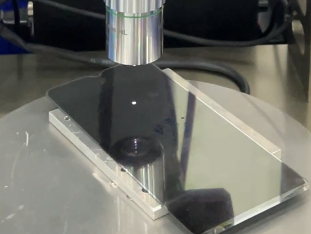
Industry Pain Points: High-end smartphone displays demand extremely high thickness uniformity (tolerance must be controlled within ±1μm). Traditional contact-based measurement methods risk scratching the panel, while laser triangulation is susceptible to interference from ambient light.
Solution: The POMEAS Point Spectral Confocal Sensor (e.g., SFS-D8040) achieves non-contact sub-micron measurement with a 40mm minimum measurement distance and 7mm measurement range. On a leading smartphone manufacturer's production line, this sensor completes thickness inspection of curved glass panels at 20 seconds per piece, delivering measurement repeatability of ±0.5μm and boosting yield by 12%.
Technical Advantages:
-
Environmental Interference Resistance: Numerical aperture of 0.31 enables stable capture of reflected spectra even under low-light conditions;
-
Dynamic Compensation Algorithm: Automatically corrects material refractive index variations, with measurement error on transparent/reflective surfaces ≤0.005mm.
Case Study 2: Lithium Battery Electrode Thickness Control—Ensuring Battery Safety

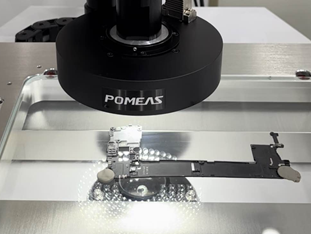
Industry Challenge: Fluctuations in lithium battery electrode thickness exceeding ±2μm lead to inconsistent battery capacity and even short-circuit risks. Traditional beta ray thickness gauges pose radiation safety hazards.
Solution: The POMEAS SFS-D8022 sensor paired with the SFS-C8001 controller integrates into automated production lines via analog output for real-time online measurement. In a new energy enterprise application, this system scans electrode surfaces at 0.1 seconds per point, achieving thickness control accuracy of ±0.8μm and improving separator thickness detection consistency by 95%.
Technical Advantages:
-
Non-contact measurement: Prevents damage to electrode surface coatings;
-
3D topography analysis: CCS VR1.0.2.4 software supports analysis of electrode surface waviness to optimize coating processes.
Case Study 3: Optical Lens Center Thickness Inspection—Solving the Challenge of Measuring Transparent Materials

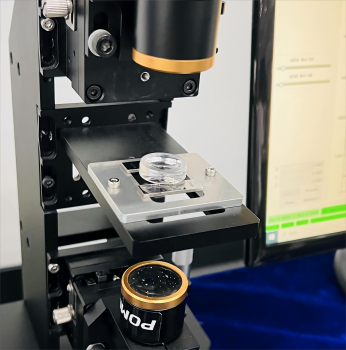
Industry Pain Points: Traditional micrometers leave pressure marks when measuring optical lenses, while laser interferometers demand stringent surface flatness.
Solution: POMEAS Spectral Confocal Sensors utilize spectral dispersion principles to locate lens surfaces by analyzing reflected light wavelength peaks. In a case study at a precision optics manufacturer, this sensor achieved non-destructive measurement of lenses with diameters up to 69mm and thicknesses ranging from 1-4mm. It delivered center thickness measurement accuracy of ±5μm and curvature radius measurement repeatability ≤0.01mm.
Technical Advantages:
-
Multi-wavelength fusion technology: Eliminates interference from double-surface reflections in transparent materials;
-
Wide beam angle design: ±20.2° reception angle accommodates complex curved surface measurements.
Case Study 4: Scanning the Surface Profile of Curved Metal Components—Redefining Non-Contact Measurement Standards

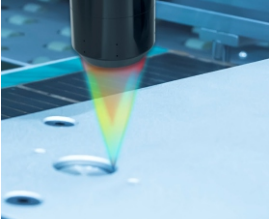
Industry Pain Points: Traditional contact probes struggle to accurately capture minute variations on curved surfaces, while laser distance meters are prone to speckle noise on highly reflective metal surfaces.
Solution: POMEAS sensors combine a 3D precision scanning mechanism with spectral confocal technology to generate high-precision 3D contour maps of curved metal components. In an application for an automotive parts manufacturer, this solution can inspect the edge radius (R0.2-R1mm) of engine blades with measurement repeatability of ±0.3μm, achieving a threefold increase in inspection efficiency.
Technical Advantages:
-
Non-contact non-destructive testing: Prevents scratches on metal surfaces;
-
Sub-micron resolution: Enables identification of micron-level topographical features.
Three Core Values of Choosing POMEAS
1. Technology Iteration Assurance: Three annual product upgrades, supporting free software iterations and calibration curve optimization;
2. Full-Scene Adaptability: Customized probes and integrated solutions for applications ranging from microelectronic chips to large automotive components;
3. Service Response Efficiency: Eight regional service centers established nationwide, guaranteeing 4-hour rapid response and 24-hour spare parts delivery.
Product recommendation
TECHNICAL SOLUTION
MORE+You may also be interested in the following information
FREE CONSULTING SERVICE
Let’s help you to find the right solution for your project!
 ASK POMEAS
  PRICE INQUIRY
  REQUEST DEMO/TEST
  FREE TRIAL UNIT
  ACCURATE SELECTION
- APPICATION CASE
- RESOURCE CENTER
- DOWNLOAD CENTER
SOLUTIONS SUPPORT
- ZOOM LENS SELECTION TOOL
- TELECENTRIC LENS SELECTION TOOL
- FA LENS SELECTION TOOL
- ZOOM RATIO TABLE
- CERTIFIED MODEL
SELECTION TOOL
- WHY POMEAS
- FAQ
- PRIVACY POLICY
- TERMS OF USE
- DELIVERY & RETURN POLICY
CUSTOMER CARE
 ADDRESS
Add.:No.68, Chongwei Road, Baizhoubian, East district, Dongguan, China, 523000
CONTACT
 Tel:+ 86-0769-2266 0867
 Fax:+ 86-0769-2266 0867
 E-mail:marketing@pomeas.com

Wechat QR code

Software Copyright :2021SR0176001 抄袭必究, 技术支持:誉新源科技