


FA Lens Case Study | Visual Inspection Solution for Tablet Chipping and Bottle Cap Sealing
In the food and pharmaceutical industries, quality compliance and safety traceability are non-negotiable red lines. Minor defects such as chipped tablets, poorly sealed caps, or damaged packaging can not only trigger product recalls and regulatory penalties but also directly threaten consumer health and brand reputation. Traditional manual inspection methods, constrained by fatigue and accuracy limitations, struggle to meet the quality control demands of high-speed production lines.

Core Detection Scenarios

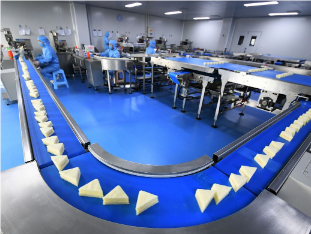
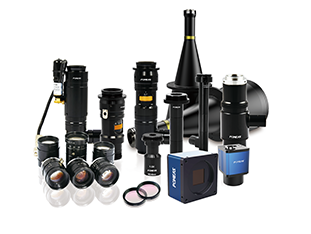
Inspection scenarios in food and pharmaceutical production lines are complex and diverse, requiring precise identification of minute defects, full-angle coverage during high-speed motion, and effective imaging solutions for materials with varying properties—such as transparent bottle caps and aluminum foil blister packs. The POMEAS FA lens family (fixed-focus, telecentric, and macro series) achieves comprehensive coverage across these three core scenarios through precisely matched parameters.

Scenario 1: Tablet Chipping, Cracking, and Blister Packaging Inspection


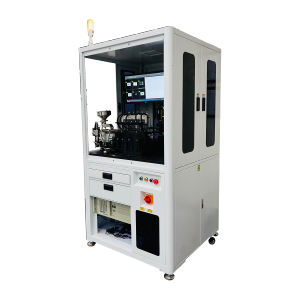
As precision pharmaceutical preparations, tablets may experience impaired drug release due to minute defects like 0.1mm-level chipping or cracking. Meanwhile, blister packaging defects such as seal leaks or empty blisters directly pose contamination risks. Traditional inspection relies on manual visual checks, achieving less than 85% identification accuracy and failing to accommodate production speeds exceeding five tablets per second.
The POMEAS solution centers on a high-resolution macro FA lens paired with a dual telecentric optical design, achieving dual technological breakthroughs: First, it eliminates perspective distortion to ensure precise imaging of tablet edge contours, clearly capturing even minute chipping and hairline cracks. Defect recognition accuracy reaches 10μm/pixel, with identification rates consistently exceeding 99.5%. Second, it adapts to the reflective properties of blister packaging. Through precise aperture control and polarization light adaptation, it effectively suppresses reflective interference from aluminum foil and plastic materials, clearly revealing defects such as wrinkles and seal failures along the sealing edges.
Scenario 2: 360° Sealing Integrity Inspection for Bottle Caps

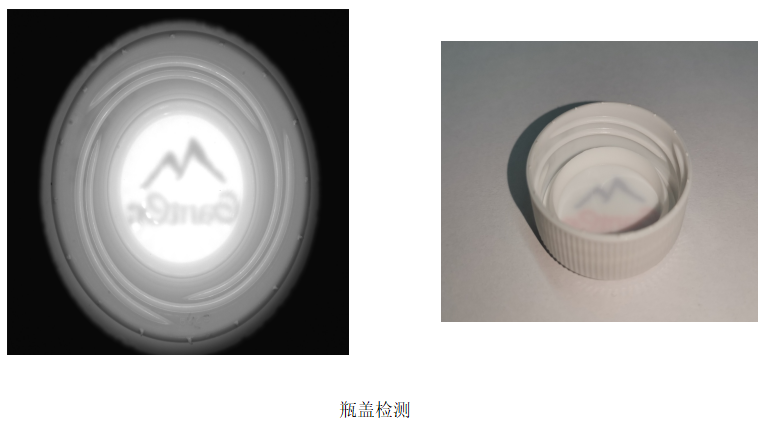
The sealing integrity of caps for food and beverage containers and oral formulations directly impacts product shelf life and safety. Defects such as loosening, missing sealing rings, and damaged side walls require full-angle coverage inspection. Traditional single-camera plus fisheye lens solutions are prone to distortion, exhibit high rates of missed defects, and suffer from limited inspection speeds.
Scenario 3: Food and Pharmaceutical Packaging Damage and Label Compliance Inspection
Secondary and tertiary packaging in food and pharmaceutical industries (e.g., paper cartons, shrink wrap, outer shipping boxes) requires inspection for defects such as damage, tears, misaligned labels, and blurred batch codes. Traditional inspection methods struggle to balance wide-field coverage with detailed recognition, and are easily affected by packaging materials (e.g., transparent shrink wrap, matte paper cartons).
POMEAS employs a combination solution of line-scan FA lenses and fixed-focus lenses, precisely tailored for different packaging types: For large-area packaging like shrink wrap and paper cartons, the line-scan FA lens paired with a linear light source enables high-speed continuous imaging, capturing pinholes and tears as small as 0.1mm.
II. Core Advantages of the Solution
-
Compliance Assurance: The entire FA lens series meets clean production requirements for the food and pharmaceutical industries, supporting real-time storage and traceability of inspection data.
-
Highly Adaptive Optical Design: Addressing the diverse materials in food and pharmaceutical applications (transparent, reflective, matte), the lenses feature multi-layer anti-reflective coatings, polarization adaptation, and low-distortion optical structures. This ensures stable imaging in complex scenarios without frequent adjustment of inspection parameters.
-
High-Speed Precision Balance: Achieves seamless integration between high-speed production lines and high-precision inspection through optimized frame rates and encoder trigger adaptation.
-
Optimized Total Cost of Ownership: Optical components exceed 50,000 hours of operational lifespan, complemented by modular design for simplified maintenance.
Product recommendation
TECHNICAL SOLUTION
MORE+You may also be interested in the following information
FREE CONSULTING SERVICE
Let’s help you to find the right solution for your project!
 ASK POMEAS
  PRICE INQUIRY
  REQUEST DEMO/TEST
  FREE TRIAL UNIT
  ACCURATE SELECTION
- APPICATION CASE
- RESOURCE CENTER
- DOWNLOAD CENTER
SOLUTIONS SUPPORT
- ZOOM LENS SELECTION TOOL
- TELECENTRIC LENS SELECTION TOOL
- FA LENS SELECTION TOOL
- ZOOM RATIO TABLE
- CERTIFIED MODEL
SELECTION TOOL
- WHY POMEAS
- FAQ
- PRIVACY POLICY
- TERMS OF USE
- DELIVERY & RETURN POLICY
CUSTOMER CARE
 ADDRESS
Add.:No.68, Chongwei Road, Baizhoubian, East district, Dongguan, China, 523000
CONTACT
 Tel:+ 86-0769-2266 0867
 Fax:+ 86-0769-2266 0867
 E-mail:marketing@pomeas.com

Wechat QR code

Software Copyright :2021SR0176001 抄袭必究, 技术支持:誉新源科技