


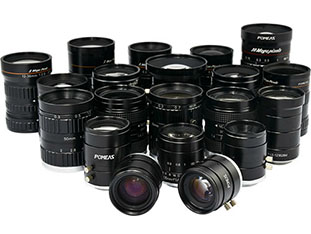
In the fields of industrial optics and precision measurement, the core considerations for selecting industrial lenses extend beyond explicit metrics like resolution, focal length, and aperture. Edge sharpness, chromatic aberration correction, mechanical stability, distortion control, and glare resistance collectively form the five critical hidden indicators that determine a lens's actual performance under operational conditions. These metrics directly impact the measurement accuracy, inspection stability, and long-term durability of machine vision systems, representing the key focal points of POMEAS Industrial Lenses' core technological advantages.
1. Edge Sharpness
The “sharpness” of industrial lenses is often simplistically interpreted as central clarity. However, in automated inspection scenarios, edge sharpness is the core factor determining imaging quality across a large field of view. Ordinary lenses can only guarantee resolution in the central area, while peripheral regions are prone to blurring and softness, leading to misidentification of workpiece edges and minute defects. POMEAS industrial lenses achieve uniform sharpness across the entire field of view through specialized optical lens group design and high-precision optical path calibration. Even at the image periphery, they clearly reproduce fine textures and dimensional boundaries of workpieces, ensuring measurement data consistency. This makes them particularly suitable for applications like large-area circuit board inspection and wafer appearance screening.
2. Chromatic Aberration Correction
Chromatic aberration occurs when light of different wavelengths refracts unevenly through a lens, resulting in imaging errors. This manifests as colored fringing along image edges, directly compromising dimensional measurement accuracy. In industrial inspection, variations in material and color of workpieces can cause standard lenses' chromatic aberration defects to trigger false detections. POMEAS industrial lenses employ low-dispersion optical glass and apochromatic correction technology to precisely calibrate the visible light spectrum. This effectively eliminates color fringing and imaging shifts, achieving chromatic aberration-free imaging across the entire spectrum. This meets the high-precision inspection demands for highly reflective metal parts, colored components, and similar applications.
3. Mechanical Stability
Industrial environments involve vibration, temperature fluctuations, and frequent focusing adjustments. A lens's mechanical stability directly determines the system's long-term reliability. This stability encompasses barrel material rigidity, lens group fixation, and the locking precision of focus/aperture rings. Conventional lenses are prone to lens displacement and barrel deformation under prolonged vibration or temperature changes, causing imaging parameter drift and requiring frequent recalibration. POMEAS industrial lenses utilize high-strength aerospace-grade alloy barrels, paired with anti-loosening focus mechanisms and sealed designs. They withstand a wide temperature range of -20°C to 60°C and sustained mechanical vibration, ensuring consistently stable imaging performance during 24/7 production line operation. This significantly reduces equipment maintenance costs.
4. Distortion Control
Distortion refers to geometric distortion during lens imaging, categorized as pincushion or barrel distortion. In high-precision dimensional measurement, even a 0.1% distortion rate can cause significant measurement errors. Unlike consumer-grade lenses, industrial lenses require sub-pixel level distortion control. POMEAS employs aspheric lens design and optical path algorithms to compensate for distortion, keeping distortion rates below 0.1%. Some high-end models even achieve “zero distortion” imaging, ensuring the projected image perfectly matches the geometric proportions of the actual workpiece. This provides a precise pixel-to-dimension mapping reference for vision measurement systems.
5. Anti-Glare Capability
In industrial inspection, highly reflective workpieces (e.g., metal parts, glass panels) often cause intense light reflections. Ordinary lenses may exhibit glare, halos, or ghosting, obscuring surface defects and details. Anti-glare capability depends on lens coating technology and the light-shielding design of the lens assembly. POMEAS industrial lenses employ multi-layer anti-reflective coating technology to effectively reduce light reflectivity on the lens surface. Simultaneously, the internal light-damping structure of the lens barrel suppresses stray light interference. Even in high-glare environments with highly reflective workpieces, these lenses clearly reveal minute defects such as scratches and cracks on the workpiece surface, enhancing the inspection system's resistance to interference.

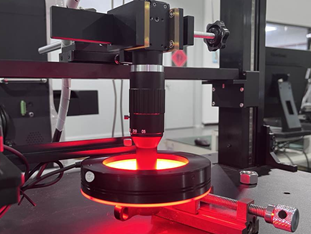
These five key performance indicators are the cornerstone for measuring the true capabilities of industrial lenses. They also represent the technical foundation that enables POMEAS to specialize in industrial optics, delivering stable and reliable imaging solutions for automated inspection and precision measurement applications.
Product recommendation
TECHNICAL SOLUTION
MORE+You may also be interested in the following information
FREE CONSULTING SERVICE
Let’s help you to find the right solution for your project!
 ASK POMEAS
  PRICE INQUIRY
  REQUEST DEMO/TEST
  FREE TRIAL UNIT
  ACCURATE SELECTION
- APPICATION CASE
- RESOURCE CENTER
- DOWNLOAD CENTER
SOLUTIONS SUPPORT
- ZOOM LENS SELECTION TOOL
- TELECENTRIC LENS SELECTION TOOL
- FA LENS SELECTION TOOL
- ZOOM RATIO TABLE
- CERTIFIED MODEL
SELECTION TOOL
- WHY POMEAS
- FAQ
- PRIVACY POLICY
- TERMS OF USE
- DELIVERY & RETURN POLICY
CUSTOMER CARE
 ADDRESS
Add.:No.68, Chongwei Road, Baizhoubian, East district, Dongguan, China, 523000
CONTACT
 Tel:+ 86-0769-2266 0867
 Fax:+ 86-0769-2266 0867
 E-mail:marketing@pomeas.com

Wechat QR code

Software Copyright :2021SR0176001 抄袭必究, 技术支持:誉新源科技