


In a double-telecentric system, the principal rays on both the object side and the image side are parallel to the optical axis; in a single-telecentric system, only the object side satisfies the telecentric characteristics. This ultimately results in significant differences in measurement accuracy, resistance to interference, and applicable scenarios.

I. Differences in Core Optical Paths and Error Resistance

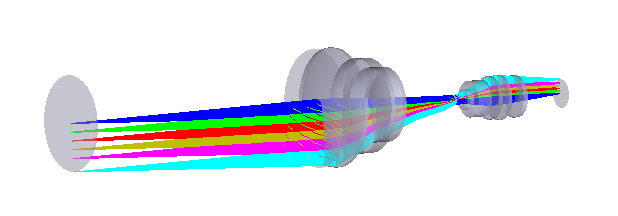
1. Single-telecentric lens: The aperture diaphragm is placed only at the image-side focal plane, and only the principal rays on the object side are parallel to the optical axis. This design can only eliminate changes in magnification caused by Z-axis displacement of the object; sensor mounting offset and image-plane defocus will still introduce slight shifts in image size.
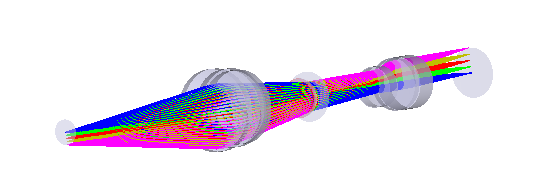
2. Double-telecentric lens: The aperture diaphragm is positioned at the common focal plane of the object and image sides, and the principal rays on both the object and image sides are parallel to the optical axis. Object Z-axis displacement, sensor mounting offset, and image plane defocus will not alter the position where the principal rays fall on the sensor, resulting in a more thorough maintenance of constant magnification.
II. Differences in Actual Measurement Accuracy

1. Single telecentric lens: Under normal operating conditions, it can limit measurement errors to the 5–10 μm range, with a telecentricity of typically around 0.1° and a distortion rate generally below 0.1%, meeting the requirements of the vast majority of medium-precision industrial measurement applications.
2. Double-telecentric lenses: With a telecentricity better than 0.05° and a distortion rate often below 0.05%, these lenses can still keep dimensional errors within 0.2% even under extreme conditions where the working distance is offset by 4 mm. Their measurement repeatability far exceeds that of single-telecentric lenses, enabling high-precision measurements at the micrometer or even submicrometer level.
III. Differences in Imaging and Performance Characteristics

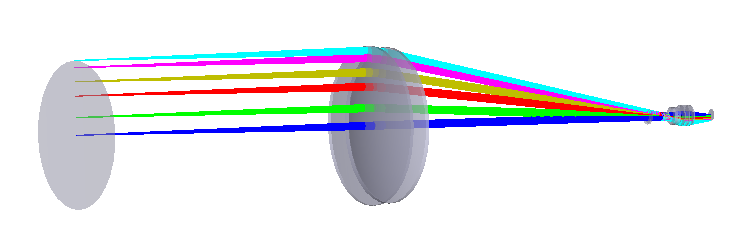
1. Single telecentric lens: Since the principal rays on the image side have different angles of incidence, slight brightness attenuation may occur at the edges of the sensor. However, this design allows for relatively宽松 tolerances on camera mounting position, and the lens is smaller and less expensive.
2. Double-telecentric lenses: The principal rays on the image plane strike the entire sensor area perpendicularly, completely eliminating cos⁴θ brightness attenuation. The illuminance across the entire image is highly uniform, and when combined with a collimated backlight, extremely high edge contrast can be achieved. However, the lens structure is more complex, the size is larger, and the cost is significantly higher.
IV. Differences in Typical Use Cases

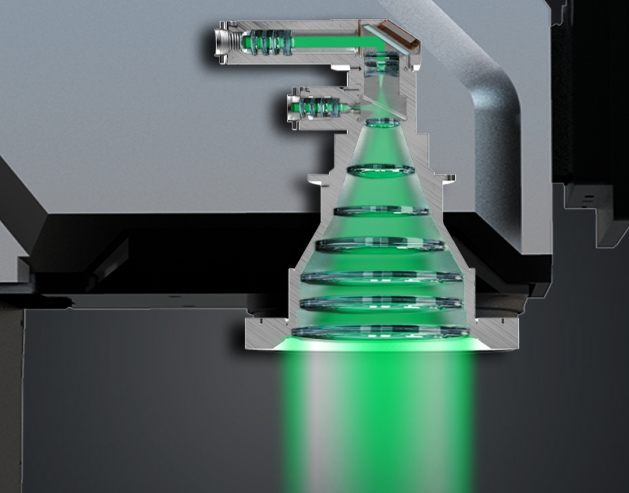
1. Single-telecentric lens: Suitable for standard applications requiring 5–10 μm-level precision, such as dimensional inspection of general mechanical parts and routine appearance measurement on assembly lines. This option is recommended for projects where cost and installation space are critical considerations.
2. Dual-telecentric lenses: Suitable for applications requiring ultra-high precision at the micrometer level, such as semiconductor chip pin measurement, dimensional inspection of precision bearing thrust washers, and photolithography-grade precision metrology. These are the preferred choice for applications with ample budgets and extremely high requirements for measurement stability.
Product recommendation
TECHNICAL SOLUTION
MORE+You may also be interested in the following information
FREE CONSULTING SERVICE
Let’s help you to find the right solution for your project!
 ASK POMEAS
  PRICE INQUIRY
  REQUEST DEMO/TEST
  FREE TRIAL UNIT
  ACCURATE SELECTION
- APPICATION CASE
- RESOURCE CENTER
- DOWNLOAD CENTER
SOLUTIONS SUPPORT
- ZOOM LENS SELECTION TOOL
- TELECENTRIC LENS SELECTION TOOL
- FA LENS SELECTION TOOL
- ZOOM RATIO TABLE
- CERTIFIED MODEL
SELECTION TOOL
- WHY POMEAS
- FAQ
- PRIVACY POLICY
- TERMS OF USE
- DELIVERY & RETURN POLICY
CUSTOMER CARE
 ADDRESS
Add.:No.68, Yongwei Road, Baizhoubian, Dongcheng District, Dongguan, China,523000
CONTACT
 Tel:+ 86-0769-2266 0867
 Fax:+ 86-0769-2266 0867
 E-mail:marketing@pomeas.com

Wechat QR code

Software Copyright :2021SR0176001 抄袭必究, 技术支持:誉新源科技