


Essential Reading for Beginners: What Are the Most Common FA Lenses?
In the field of defect detection, FA (Factory Automation) lenses serve as the critical component connecting cameras to inspection targets, with their performance directly impacting detection accuracy and efficiency. Based on functionality and application scenarios,Common types of FA lenses include fixed-focus lenses, Vari-focal lenses, telecentric lenses, macro lenses, and polarizing lenses.

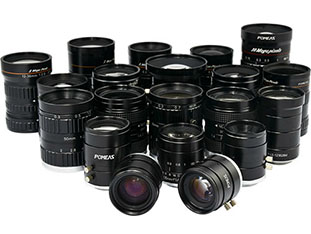
1. FA Fixed-Focus Lens: The “Basic Model” for Fixed-Size Inspection
- Core Characteristics: Fixed focal length (e.g., 8mm, 12mm, 16mm, etc.), with the field of view decreasing as the focal length increases (e.g., an 8mm focal length yields a field of view of approximately 60°, while a 50mm focal length yields a field of view of approximately 10°).
- Advantages: Simple structure, stable imaging, low cost (unit price: 500-1500 RMB), suitable for automated inspection of most fixed-size parts.
- Limitations: Requires lens replacement when detecting changes in object dimensions, making it unsuitable for multi-size flexible automated lines.
- Typical Scenarios:
- 3C Electronics Inspection: For example, visual inspection of mobile phone chargers (dimensions 30mm × 20mm) using a 16mm fixed-focus lens achieves a 99.3% defect detection rate for scratches, chipped corners, and similar flaws.
- Standardized Packaging Inspection: For instance, static dimensional measurement of bolt diameters and bearing thicknesses.
2. FA Vari-focal lenses: The Flexible Option for Multi-Size Flexible Inspection
- Core Features: Manual or motorized focal length adjustment (e.g., 8-50mm, 12-72mm), with field of view varying according to focal length.
- Advantages: A single lens covers multiple size inspection requirements, eliminating frequent lens changes and adapting to small-batch, multi-variety production.
- Limitations: Higher cost (manual zoom: ¥1,500–3,000; motorized zoom: ¥3,000–5,000), with motorized models requiring additional control signal connections.
- Typical Scenarios:
- Automotive Component Inspection : Detection of deformation and notches in multi-size clips (5mm-40mm), nachieved using 12-50mm motorized Vari-focal lenses for non-stop production during changeovers.
- Home Appliance Component Inspection : Surface defect detection on plastic housings of various specifications.
3. FA Telephoto Lens: The Precision Model for High-Accuracy Dimension Measurement
- Core Features:
- Low distortion rate (≤0.1%), eliminating measurement errors caused by “near large, far small” perspective distortion.
- No perspective error: Consistent image size across different part positions ensures measurement results remain unaffected by placement shifts.
- Advantages: High dimensional measurement accuracy (up to ±0.001mm to ±0.01mm), suitable for high-precision applications such as semiconductors and optical components.
- Limitations: Higher cost (objective telecentric lenses range from 2,000 to 5,000 yuan), fixed working distance (requires strict control of the distance between the lens and the part).
- Typical Scenarios:
- Semiconductor chip inspection: For applications such as pin pitch measurement (accuracy requirement ±0.005mm), telecentric lenses can increase soldering yield from 85% to 99.6%.
- Precision hardware inspection: For applications such as measuring gear pitch and thread pitch.
4. FA Macro Lens: The Magnified Solution for Inspecting Tiny Components
- Core Features: Short focal length, high magnification, capable of capturing minute details.
- Advantages: Suitable for defect detection on minute components (such as chip pins and solder joints of electronic components).
- Typical Scenarios:
- Chip Pin Inspection: Identification of pin defects such as missing or bent pins.
- SMT Placement Inspection: Detection of solder joint defects including cold solder joints and bridging.
5. FA Polarizing Lens: The “Extinction Model” for Inspecting Highly Reflective Components
- Core Feature: Eliminates reflections through a polarizing filter to enhance image contrast.
- Advantages: Suitable for detecting surface defects on highly reflective materials such as metal and glass.
- Typical Scenarios:
- Automotive metal shell inspection: Identification of defects such as scratches and dents.
- Glass bottle defect inspection: Detection of flaws such as cracks and bubbles.
Model Selection Recommendations
-
Fixed-size inspection: Opt for FA fixed-focus lenses to balance cost and stability.
-
Multi-size flexible inspection: Select FA Vari-focal lenses to enhance production line flexibility.
-
High-precision dimensional measurement: Choose FA telecentric lenses to ensure measurement consistency.
-
Micro-part inspection: Select FA macro lenses to capture fine details.
-
Highly reflective part inspection: Opt for FA polarizing lenses to eliminate glare interference.
Product recommendation
TECHNICAL SOLUTION
MORE+You may also be interested in the following information
FREE CONSULTING SERVICE
Let’s help you to find the right solution for your project!
 ASK POMEAS
  PRICE INQUIRY
  REQUEST DEMO/TEST
  FREE TRIAL UNIT
  ACCURATE SELECTION
- APPICATION CASE
- RESOURCE CENTER
- DOWNLOAD CENTER
SOLUTIONS SUPPORT
- ZOOM LENS SELECTION TOOL
- TELECENTRIC LENS SELECTION TOOL
- FA LENS SELECTION TOOL
- ZOOM RATIO TABLE
- CERTIFIED MODEL
SELECTION TOOL
- WHY POMEAS
- FAQ
- PRIVACY POLICY
- TERMS OF USE
- DELIVERY & RETURN POLICY
CUSTOMER CARE
 ADDRESS
Add.:No.68, Chongwei Road, Baizhoubian, East district, Dongguan, China, 523000
CONTACT
 Tel:+ 86-0769-2266 0867
 Fax:+ 86-0769-2266 0867
 E-mail:marketing@pomeas.com

Wechat QR code

Software Copyright :2021SR0176001 抄袭必究, 技术支持:誉新源科技