


What is the difference between “dual-remote-center” and “object-square-remote-center”?
In the field of industrial vision inspection, telecentric lenses have become essential tools for high-precision measurement due to their unique optical design. Among these, “dual telecentric” and “object-side telecentric” represent two common types, each exhibiting significant differences in technical characteristics and application scenarios.

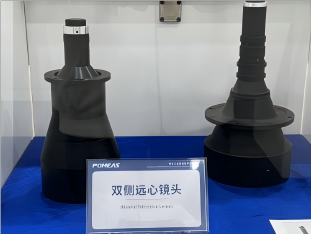
I. Technical Differences: Bidirectional Error Cancellation vs. Unidirectional Optimized Imaging
Double-telecentric lens:
The core advantage of a dual-telecentric lens lies in its bidirectional telecentric design, which simultaneously possesses both object-side and image-side telecentric properties. Object-side telecentricity ensures incident light rays remain parallel to the optical axis, eliminating perspective errors caused by object position shifts. Image-side telecentricity ensures exit light rays also remain parallel to the optical axis, preventing magnification changes due to imaging plane displacement (such as sensor mounting errors). This dual-axis design enables the dual telecentric lens to maintain consistent measurement accuracy regardless of movement occurring either at the object side or the imaging plane, achieving ultimate error control.
Far-Field Lens:
Object-side telecentric lenses are optimized for telecentricity only on the object side, meaning they ensure only that incident rays remain parallel to the optical axis. By eliminating perspective errors caused by object position shifts, they enhance measurement accuracy but remain insensitive to shifts in the imaging plane position. Consequently, object-side telecentric lenses excel in scenarios where the imaging plane is fixed or where high tolerance for subject-side errors exists. However, they cannot comprehensively eliminate bidirectional errors like dual telecentric lenses do.
II. Application Scenarios: Highest Precision Measurement vs. Cost-Effective Choice
Double-telecentric Lens: The Choice for Highest Precision Measurement
The bidirectional error compensation capability of double-flange lenses makes them an ideal choice for scenarios demanding extremely high precision. For example:
- Precision Assembly Inspection: In processes such as semiconductor packaging and precision mechanical assembly, even minute component displacement or imaging plane installation errors can cause measurement failures. Dual telecentric lenses utilize a bidirectional telecentric design to ensure stable and reliable measurement results regardless of object or imaging plane movement.
- High-Precision 3D Measurement: In scenarios requiring simultaneous acquisition of multiple dimensional information about an object, double telecentric lenses prevent measurement deviations caused by the accumulation of object-side and image-side errors, enhancing the accuracy of 3D reconstruction.
- Research-Grade Microscopic Imaging: In fields like materials science and life sciences, when performing high-precision imaging of microscopic structures in samples, dual telecentric lenses eliminate image distortion caused by minute shifts in sample position or imaging system movement, ensuring the reliability of research data.
Far-Field Lens: The Cost-Effective Choice for Scenarios Demanding High Thickness Measurement or Depth of Field
Although parabolic telecentric lenses fall short of dual telecentric lenses in bidirectional error control, they offer lower costs and simpler structures, providing significant advantages in the following scenarios:
- Thick Object Dimension Measurement: For objects like metal sheets and plastic parts, object-side telecentric lenses eliminate perspective errors caused by object thickness, enabling precise measurements without incurring additional costs for image-side telecentric functionality.
- Scenarios Requiring Large Depth of Field: In applications needing simultaneous clear imaging of multiple height planes (e.g., multi-layer circuit board inspection), the object-side telecentric lens ensures sharp imaging across all planes through its large depth of field capability, eliminating the need for complex optical adjustments.
- High-Precision Inspection with Limited Budget: For inspection tasks sensitive to object-side errors but tolerant of image-side errors (e.g., dimensional verification of certain mechanical parts), object-side telecentric lenses provide sufficient accuracy assurance at a lower cost.
Product recommendation
TECHNICAL SOLUTION
MORE+You may also be interested in the following information
FREE CONSULTING SERVICE
Let’s help you to find the right solution for your project!
 ASK POMEAS
  PRICE INQUIRY
  REQUEST DEMO/TEST
  FREE TRIAL UNIT
  ACCURATE SELECTION
- APPICATION CASE
- RESOURCE CENTER
- DOWNLOAD CENTER
SOLUTIONS SUPPORT
- ZOOM LENS SELECTION TOOL
- TELECENTRIC LENS SELECTION TOOL
- FA LENS SELECTION TOOL
- ZOOM RATIO TABLE
- CERTIFIED MODEL
SELECTION TOOL
- WHY POMEAS
- FAQ
- PRIVACY POLICY
- TERMS OF USE
- DELIVERY & RETURN POLICY
CUSTOMER CARE
 ADDRESS
Add.:No.68, Chongwei Road, Baizhoubian, East district, Dongguan, China, 523000
CONTACT
 Tel:+ 86-0769-2266 0867
 Fax:+ 86-0769-2266 0867
 E-mail:marketing@pomeas.com

Wechat QR code

Software Copyright :2021SR0176001 抄袭必究, 技术支持:誉新源科技