


VGA Industrial Cameras: A Comprehensive Analysis of Principles and Applications
The VGA industrial camera, featuring a fixed resolution of 640×480, remains a classic entry-level industrial vision tool with unique value in high-speed basic inspection and positioning applications. Its advantages include high frame rates, low cost, and minimal system load.

I. Core Concepts and Principles of VGA Industrial Cameras
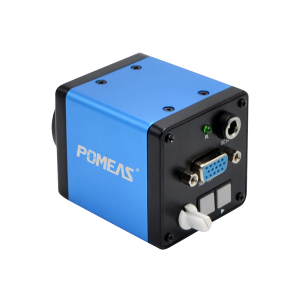
VGA industrial cameras refer to industrial digital cameras with a fixed resolution of 640x480 pixels (i.e., 300,000 pixels, 0.3 megapixels). The name originates from the early Video Graphics Array display standard.
1. Imaging Principle: Typically employing CCD or CMOS sensors, incident light signals are converted into electrical signals. In VGA cameras, the physical arrangement of effective pixels on the sensor is 640 columns × 480 rows. The analog signals captured by the sensor undergo analog-to-digital conversion (ADC) to become digital signals, which are then processed by the camera's internal image processor for gain adjustment, white balance, noise reduction, and other operations. The resulting 640x480 image data is ultimately transmitted to a host computer (typically an industrial PC) via digital interfaces such as the classic IEEE 1394a/b, USB 2.0, later GigE, or Camera Link.
2. Differences Between Industrial and Consumer-Grade VGA Cameras: Industrial cameras are engineered for harsh environments (temperature, vibration, electromagnetic interference). They utilize industrial-standard interfaces with stable protocols and strong interference resistance, ensuring long-term continuous and reliable transmission. They provide stable SDKs and support multiple industrial image processing libraries (e.g., Halcon, OpenCV), facilitating easy integration into automation systems. They allow precise software control over parameters like exposure time, gain, and triggering to meet synchronized acquisition requirements. They typically use standard industrial lenses with C-mount or CS-mount, enabling interchangeable lenses to accommodate varying field-of-view and depth-of-field needs.
II. Core Features of VGA Industrial Cameras
-
Fixed and relatively low resolution: 640x480 is its most distinctive feature. In today's camera market where resolutions routinely reach millions or even hundreds of millions of pixels, it falls into the “low resolution” category.
-
High Frame Rate: Due to its small data size (approximately 0.3MB per uncompressed image), the VGA camera achieves exceptionally high frame rates under the same bandwidth conditions. For instance, via the Camera Link interface, it easily surpasses 200fps, making it ideal for analyzing high-speed motion.
-
Low cost: The sensors are compact, and the processor requirements are minimal, resulting in overall hardware costs significantly lower than those of high-resolution cameras.
-
Low system burden: Reduced data volume translates to less computational load on the processor, lower storage space requirements, and diminished bandwidth demands. Consequently, the overall cost of the vision system—including the PC, capture card, and storage—is significantly reduced.
-
Global Shutter vs. Rolling Shutter: Industrial VGA cameras typically offer global shutter models, suitable for capturing fast-moving objects without distortion—a feature lacking in many consumer-grade cameras.
III. Application Scenarios for VGA Industrial Cameras
-
High-Speed Online Inspection and Counting: ① Cap/Label Presence Detection: Rapidly assess basic product attributes on high-speed filling lines. ② Component Counting and Orientation Detection: Quickly count or identify orientation of small parts (e.g., screws, capsules). ③ QR Code/Barcode Reading (Simple Positioning): VGA cameras suffice for clearly printed, fixed-position barcodes.
-
Machine Vision Guidance and Positioning:
① PCB Board Alignment: Guides robots or motion platforms to locate board edges or reference points during circuit board assembly.
② Chip Pin Inspection: Rapidly determines pin presence and bending (for applications with low detail requirements). -
Basic Measurement and Dimensional Inspection:
Performs one-dimensional or two-dimensional measurements (length, width, diameter) on objects with non-critical dimensional tolerances (e.g., >0.1mm). -
Scientific Research and High-Speed Photography: In fields requiring extremely high frame rates (hundreds to thousands of fps), such as Particle Image Velocimetry (PIV) and ballistic trajectory analysis, VGA resolution is often used to prioritize speed.
-
Embedded and Space-Constrained Systems: Integration into compact devices, handheld inspection tools, or systems with strict power consumption limitations.
IV. Advantages of VGA Industrial Cameras
-
Ultimate Cost-Effectiveness: The most economical solution for meeting basic visual requirements.
-
High-Speed Performance: Achieves high frame rates at low resolutions, ideal for dynamic scenes.
-
System Lightweighting: Reduces bandwidth, processing, and storage demands across the entire system.
-
Technologically Mature and Stable: Developed over decades, this technology is highly mature and reliable.
V. Limitations of VGA Industrial Cameras
-
Limited detail resolution: Unable to detect minute defects (e.g., microcracks, precision printing flaws).
-
Field of view versus accuracy trade-off: In wide fields of view, each pixel represents a larger physical dimension, resulting in lower measurement accuracy. To improve accuracy, the field of view must be reduced.
-
Gradually being displaced by high-definition cameras: With the widespread adoption of interfaces like USB 3.0 and GigE, 2-megapixel (1080p) cameras have achieved highly competitive cost and speed levels, establishing themselves as the new benchmark in many applications.
-
Limited functionality: Typically lacks the built-in processing capabilities of smart cameras, requiring an external PC.
Product recommendation
TECHNICAL SOLUTION
MORE+You may also be interested in the following information
FREE CONSULTING SERVICE
Let’s help you to find the right solution for your project!
 ASK POMEAS
  PRICE INQUIRY
  REQUEST DEMO/TEST
  FREE TRIAL UNIT
  ACCURATE SELECTION
- APPICATION CASE
- RESOURCE CENTER
- DOWNLOAD CENTER
SOLUTIONS SUPPORT
- ZOOM LENS SELECTION TOOL
- TELECENTRIC LENS SELECTION TOOL
- FA LENS SELECTION TOOL
- ZOOM RATIO TABLE
- CERTIFIED MODEL
SELECTION TOOL
- WHY POMEAS
- FAQ
- PRIVACY POLICY
- TERMS OF USE
- DELIVERY & RETURN POLICY
CUSTOMER CARE
 ADDRESS
Add.:No.68, Chongwei Road, Baizhoubian, East district, Dongguan, China, 523000
CONTACT
 Tel:+ 86-0769-2266 0867
 Fax:+ 86-0769-2266 0867
 E-mail:marketing@pomeas.com

Wechat QR code

Software Copyright :2021SR0176001 抄袭必究, 技术支持:誉新源科技