


In scenarios such as automated production lines, logistics sorting, and retail checkout, the efficiency and accuracy of barcode reading directly impact overall operational efficiency. However, many companies often fall into a misconception: believing that high-end lenses are essential to achieve high read rates. In reality, for the specific task of barcode reading, an optimized, low-cost FA (industrial) lens can often deliver equivalent or even superior results at a lower cost.


I. The Two Core Optical Requirements for Barcode Reading
The essence of barcode reading lies in capturing the contrast differences between bars and spaces (black bars and white spaces) through an image sensor, then converting them into recognizable digital signals. Therefore, lens performance must focus on two core requirements:

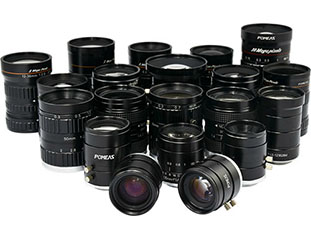
1. Brightness Control: Ensures maximum contrast between bars and gaps.
-
Barcode reading relies on contrast recognition: The accuracy of barcode scanning directly depends on the brightness difference between black bars and white spaces (i.e., contrast). If the lens has insufficient light transmission or optical path design flaws, it may cause the entire image to appear too dark or result in local overexposure, blurring the boundaries between bars and spaces.
-
Advantages of budget lenses: Basic FA lenses typically feature simplified optical designs (such as fewer lens elements), which actually reduce light energy loss. Combined with large apertures (e.g., F2.0–F2.8) and anti-reflective coatings, they ensure ample light intake while avoiding the optical attenuation caused by complex structures found in high-end lenses.
2. Distortion Control: Preserving the geometric integrity of barcodes
-
Distortion Causes Reading Errors: If a lens exhibits barrel or pincushion distortion, the straight edges of barcodes become curved, leading decoding algorithms to misjudge the width ratio of bars and spaces.
-
Targeted Optimization for Budget Lenses: For barcode reading applications, many affordable FA lenses utilize aspherical elements or symmetrical optical path designs to suppress distortion rates below 0.3% (significantly lower than the 1%-2% typical for general-purpose lenses). This cost-effective optimization fully meets the geometric precision requirements for both 1D and 2D barcodes.
II. Why Are High-End Lenses “Cost-Ineffective” for Barcode Reading?
High-end lenses (such as telecentric lenses and high-resolution microscope lenses) are typically designed for precision measurement or complex surface inspection, and their characteristics are “over-engineered” for barcode reading:
-
Telecentric lenses eliminate perspective distortion through parallel optical paths, but barcode reading demands far less geometric precision than dimensional measurement. For instance, a lens with 0.5% distortion can already ensure barcode decoding rates exceeding 99.9%, while telecentric lenses may cost 3-5 times more.
-
Barcode decoding requires only pixel-level contrast information, not sub-pixel detail. Basic 2-5 megapixel lenses adequately cover common barcode dimensions (e.g., 3-10mm width), while higher resolutions only increase data volume and processing demands.
-
High-end lenses often employ multi-element stacked designs, which enhance imaging quality but also heighten vibration sensitivity and assembly error risks. In industrial settings, simpler, lower-cost lenses prove more stable and durable.
III. Four Key Factors for Selecting FA Lenses
- Aperture and Light Transmission
- Distortion Rate
- Working Distance and Depth of Field
- Compatibility
Product recommendation
TECHNICAL SOLUTION
MORE+You may also be interested in the following information
FREE CONSULTING SERVICE
Let’s help you to find the right solution for your project!
 ASK POMEAS
  PRICE INQUIRY
  REQUEST DEMO/TEST
  FREE TRIAL UNIT
  ACCURATE SELECTION
- APPICATION CASE
- RESOURCE CENTER
- DOWNLOAD CENTER
SOLUTIONS SUPPORT
- ZOOM LENS SELECTION TOOL
- TELECENTRIC LENS SELECTION TOOL
- FA LENS SELECTION TOOL
- ZOOM RATIO TABLE
- CERTIFIED MODEL
SELECTION TOOL
- WHY POMEAS
- FAQ
- PRIVACY POLICY
- TERMS OF USE
- DELIVERY & RETURN POLICY
CUSTOMER CARE
 ADDRESS
Add.:No.68, Chongwei Road, Baizhoubian, East district, Dongguan, China, 523000
CONTACT
 Tel:+ 86-0769-2266 0867
 Fax:+ 86-0769-2266 0867
 E-mail:marketing@pomeas.com

Wechat QR code

Software Copyright :2021SR0176001 抄袭必究, 技术支持:誉新源科技